The New Yorker: November 18, 2025
“Joan
Crawford: A Woman's Face”
Brings a Star's Genius to Light
By Richard Brody
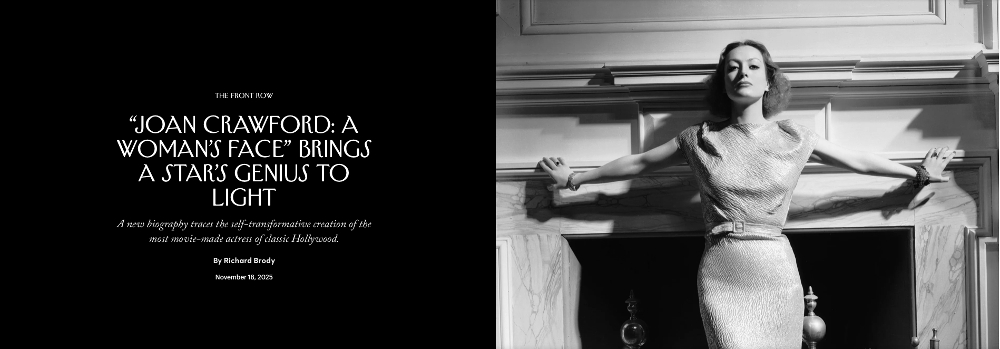
The book is a trove of anecdotes, quotes, and insights, but, above all, it’s the energetic pursuit of an idea: Eyman presents the story of Crawford’s rise to fame as the story of Hollywood stardom itself. He shows what the studio system did for and to its luminaries, how its mechanisms of assisted self-transcendence worked and what their effects were on those whom the system exalted and enriched. In Eyman’s view, it was a social and professional bubble that put intense pressure on the extreme personalities who thrived there—of which Crawford’s may be the supreme example—and who thus gave rise to the radical life styles and aesthetics for which classic Hollywood became known.
If there’s a Hollywood movie about a family anything like the one that Crawford was raised in, I haven’t seen it. Eyman searched in vain for any public record of her birth and attributes the lack of a birth certificate to either the family’s poverty or to their instability. He estimates that she was born in 1905 or 1906, possibly near San Antonio or in San Angelo, Texas. Her name was Lucille LeSueur. Her father, Thomas LeSueur, left the family around the time of her birth, and, in 1909, her mother, Anna, married Henry Cassin, a theatre manager in Lawton, Oklahoma, and moved the family there. In Lawton, Lucille was known as Billie Cassin—Billie was Cassin’s nickname for her—and she was a rambunctious child, recalled by neighbors as a “complete tomboy” and by others as malnourished. She loved vaudeville shows and movies; Cassin encouraged her to consider a career as a dancer, and she took to standing in front of the Lawton movie theatre and telling friends, “My picture will be up there one day.”
In the mid-nineteen-tens, Cassin got into financial trouble, and the family relocated to Kansas City, where Lucille worked her way through two private schools. In 1922, she enrolled at Stephens College, in Columbia, Missouri, paying for her tuition by working in the dining hall. She lasted only a semester—her educational background was inadequate, and she felt ostracized for her menial work—but she blossomed socially. A classmate said that she’d “dance all the time on the tables in the dining room and do the Charleston in the kitchen”; she became known as the town’s best Charleston dancer. And a staff member said, of Lucille, “She liked to date, and she liked the men a lot.” Her failure in college proved to be her success in life and art.
Returning to Kansas City, Lucille got a job in a department store, until, around the start of 1924, she was cast in a show as a dancer. After that show closed, she moved to Chicago, barged into a producer’s office, and got hired to dance at a night club popular with gangsters. Then the producer cast her in a show, in Oklahoma City, and in another, in Detroit, where she came to the attention of a stage manager, who hired her to dance on Broadway. She débuted there in May, and by November a Metro-Goldwyn-Mayer producer in New York had called her up for a screen test. Back in Kansas City with her mother for Christmas, and less than a year after first setting foot on a stage, she got a telegram from the studio summoning her to Hollywood and offering a six-month contract.
The studio promoted Lucille with a publicity campaign that included a movie-magazine contest to find her a new name. The magazine’s editor chose Joan Crawford, which she hated—she would ask friends to call her Billie—but the renaming helped, not only commercially but, even more, psychologically. The new public persona became her creation, even her product, and she worked madly to put it over. She got her face and her name out there as quickly and as brashly as possible. Dressed and coiffed showily, she entered (and won) dance contests in prominent restaurants that were attended by Hollywood higher-ups. A female screenwriter said, “Crude as she was, everything about her seemed to say, ‘Look out. I’m in a hurry. Make room.’ ” It was still the era of silent films, and Crawford made the most of the small roles that came her way, hanging around sets even when she wasn’t shooting, in order to learn from famous actors and skilled technicians. While acting in “Sally, Irene and Mary,” as the high-spirited and earnestly romantic member of the titular trio, Crawford learned from the cameraman John Arnold to forget what was rehearsed and to create a sense of surprise on camera. He also taught her what kind of shot mattered the most; as she recalled, “A face up close like that has such strength.”
Her acting in a wide range of roles gained notice, including from F. Scott Fitzgerald, who, in a 1927 interview, described her as “doubtless the best example of the flapper, the girl you see at smart night clubs.” By 1928, she was being cast in leading roles, specializing in women on the make: in “Our Dancing Daughters,” she played a sexually forthright socialite who’s spurned as frivolous by the man she loves; in “Our Modern Maidens” (1929), she was a fast-living heiress who seduces an older diplomat. Still, in her silent and her early talking pictures, Crawford smiles too much and flutters and joshes with forced jollity. She’s hardly recognizable as herself, except in occasional shots where she unleashes the glower—the hot, fixed gaze—that was to become her signature expression. In those early films, Eyman rightly notes, “The underlying problem was that she hadn’t quite found her look.” It would soon be created jointly by Crawford and studio artisans of style who helped to form her definitive iconography. Chief among them was the costume designer Adrian, who worked with her for twelve years, starting in 1929. The clothes he created for her, designed to emphasize her naturally broad shoulders, came to define both her own physical architecture and that of the era. Eyman says, “The look Adrian gave Crawford in the 1930s was Hollywood’s single most important influence on American fashion.”
Once Crawford slipped into her style, she never slipped out of it—not publicly. “Never in the thousands of times in our association, was she ever less than perfectly dressed, in full makeup,” a publicist at M-G-M recalled. “She was never casual, not even if it was for an audience of only 20 fans. She had an image of herself and she lived up to it.” (Moreover, Eyman notes that the studio head, Louis B. Mayer, “allowed Crawford to keep the clothes from her movies so she could look like a star at all times, and on the studio’s dime.”) Douglas Fairbanks, Jr., (whom she married in 1929 and divorced in 1933), said, “She was the hardest worker I ever saw. Her only excess I can remember was an excess of ambition. She was completely absorbed with her career and with work.”
Eyman’s thesis is that Crawford’s drive for stardom “was about finding and receiving the attention and love she had always hungered for and never had.” That reads like an M-G-M logline. For Crawford, the business of stardom, the art of performance, and the craving for self-transformation were inseparable. This art didn’t come naturally; it took years of on-the-job self-cultivation and is inextricable from the story of the formation and development of the real-life fiction that is Crawford. That’s how she became the most profoundly movie-made actor of all movie stars. For instance, her exertions extended to publicity photos; she often spent a whole day changing costumes, hairdos, and makeup for the photographer George Hurrell, who said that “she used this opportunity to try to present a new image that might possibly work for her whole screen personality.”
With her relentless quest for visual self-awareness, Crawford became an expert in cinematography. The actor Raymond Massey, one of her co-stars in “Possessed” (1947) said, “She was the best technician I ever met. Could match close-ups and long shots flawlessly. Knew everything about lighting, camera lenses, and dressed for the camera, and not the other actors.” The director Vincent Sherman, who made three movies with her in the nineteen-fifties, concurred. “She was a collaborator in working to achieve a total effect. She was the kind of person that you could talk to about the way you wanted to shoot the thing, the background, the cutting. She was conscious of everything that went on set,” he said. Crawford was obsessed with controlling her filmic appearance, recalling, “I religiously looked at my dailies every night. And I studied myself.”
Crawford worked hard at acting, too—at conveying emotion, which she did in a distinctively modern way, by actually feeling it. Never having done anything onstage but dance, she didn’t understand the art of pretending. Fairbanks again: “She could not believe that Lynn Fontanne might feel physically dreadful yet be able to perform high comedy with supreme and subtle wit. Nor could she believe that a great actress like Helen Hayes could consciously reduce audiences to uncontrollable tears while she thought about having a juicy steak sandwich after the performance.” The result was both straightforward and complex. Her speech, lacking theatrical craft, is direct, stark, and unmannered, and the finely honed artifice of her physical bearing is the basis for the immediacy and spontaneity of the emotions she unleashes. In effect, Crawford stumbled on a Method of her own making, later explaining, “I remember every one of my important roles the way I remember a part of my life, because at the time I did them, I was the role and it was my life for 14 hours a day.”
Eyman emphasizes that M-G-M was the most star-centric of all studios—and also the most top-down, executive-managed one. Directors there were under tight control, and Crawford had little regard for most of them, though she did hold one in particular esteem: George Cukor, with whom she made three films—most notably, “The Women” (1939), in which she had an indelibly vicious supporting role as a department-store sales clerk who seduces a rich married man. In that prime studio era, actors, directors, screenwriters, and even composers of scores were under long-term contract (generally, seven years), and technicians (such as cinematographers, set designers, and hairdressers) were permanent, salaried employees; as a result, each studio’s style, set from above, was baked into its movies. Crawford’s early starring roles tended toward tough women, whether laborers or dancers or playgirls, whose sexual allure is a source of power. Still, M-G-M’s notion of raciness was tamer than in other studios—and once the bowdlerizing Hays Code was put into full effect, in the mid-thirties, the studio shifted, as Eyman says, to “middle-class domestic fantasy,” which meshed poorly with Crawford’s image and her personality. Even her better films at the studio (such as Dorothy Arzner’s “The Bride Wore Red,” a trio of films directed by Frank Borzage that includes “Mannequin,” and her last one with Cukor, “A Woman’s Face,” from which Eyman’s book gets its title) were cramped by sentimentality. Her popularity declined; many in the business thought her career was over.
In 1943, Crawford asked to be released from her contract and quickly signed with Warner Bros., a brassier joint, whose roster of films emphasized hardboiled and populist dramas. The first movie in which she was cast there, “Mildred Pierce”—shot in 1944, released in 1945—won her an Oscar for Best Actress. Entering her forties, Crawford was back and bigger than ever. What’s more, she had found her artistic voice, but, unfortunately, she didn’t quite know this and wasn’t especially happy about it. When she went to Warner Bros., her style changed, hardened, and not just because of the studio: by the time she got there, she’d recently endured a breakup with a man she loved, the newspaper publisher Charles McCabe, because he was married and wouldn’t divorce his wife. She was in her third marriage, and it, too, was failing; she’d adopted children (Christina, born in 1939, and Christopher, born in 1942; later, the twins Cathy and Cindy, born in 1947), which brought additional pressure. The Second World War made for an ambient tension; her career change was stressful. She had loved the corporate protection that M-G-M offered: her responsibility was to show up on time and do her work, and it indeed took up just about all her time.
Crawford said that, in the postwar years, “the fun aspects went out of American movie-making.” And yet it was her films of this era that would prove most lasting. Postwar changes in the industry included the rise of a new and daring generation of directors and the unleashing of a new and freer range of emotions (despite the persistence of the Hays Code) resulting from the traumas of war. One of Crawford’s greatest roles came in 1947, in a furious postwar-themed drama, “Daisy Kenyon,” directed by Otto Preminger, in which she starred as a fashion illustrator torn between romance with a married and hard-edged corporate lawyer (Dana Andrews) and a widowed naval architect who’s also a traumatized veteran (Henry Fonda). The business changed even more with the antitrust consent decree of 1948, which, in effect, broke up the studios, forcing them to divest themselves of movie theatres (thus drying up a virtually guaranteed cash flow) just as they faced the new challenge of television, which started cutting deeply into the box-office. In the resulting economic crisis, Crawford, like many other actors, was taken off contract—at the end of 1951, Warner Bros. let her go, and she became a freelancer.
Circumstances again aligned to Crawford’s advantage, even if it didn’t seem so at the time. Just as her breakup with M-G-M led to better opportunities at Warner Bros., the turn to freelance work, despite increased uncertainty, gave Crawford more power and more control than she’d ever had under contract. In the mid-fifties, she starred in two movies made by two of the most explosively expressive, even expressionistic, directors of the time: Nicholas Ray’s Western “Johnny Guitar” (1954) and Robert Aldrich’s romantic melodrama “Autumn Leaves” (1956). These, along with the Preminger film, are Crawford’s supreme masterworks. Ray’s film was based on a novel by a screenwriter who had dedicated it to her; she bought the rights to it, and the deal was packaged by her and Ray’s agent, Lew Wasserman, of MCA. While at M-G-M, Crawford had been considered a consummate professional who “never stormed off a set,” her former M-G-M producer Joseph L. Mankiewicz said, and “was never a pampered star.” But, in her freelance era, Crawford knew that she held the high hand and played it with a vengeance.
On “Johnny Guitar,” she left the set mid-production and threatened not to come back unless changes were made to the script. According to Ray, she said, “Oh, hell, Nick, give it balls. Write it for Gable and I’ll play it.” According to the screenwriter Philip Yordan, she said, “I want to play the man”—a character as assertive, heroic, and violent as a great male lead in an action film. Her ultimatum proved crucial to the movie’s success, both artistically and commercially. It’s the role that pushes her style of performance—indeed, movie performance, period—to its furthest extreme of stylization. Her bearing, her facial expressions, her tightly compressed diction are the closest thing to opera that the movies have to show. The film made a handsome profit (and helped both her career and Ray’s), but it got terrible reviews, except in Paris, where the young François Truffaut enthused about the film and went into ecstasies about her performance. Then, on “Autumn Leaves,” Crawford made life hard for Aldrich with her many demands regarding costume and personal accommodations (such as the paint job and the carpet in her dressing room), leaving him to wonder if all her directors dealt with such matters “in lieu of directing.” Here, her glower—in the role of a woman in love with a troubled and violent man—trembled with bewilderment and empathy. The film won the Silver Bear award, for best director, at the Berlin Film Festival, but it wasn’t a commercial success.
Eyman misconstrues this part of Crawford’s career:
If the young Lucille or Billie’s origin story would have been too extreme for the Hollywood of the time, much the same is true of her love life once she’d arrived as a star, and Hollywood publicists stayed busy keeping the details out of the papers, just as screenwriters stayed busy keeping such subjects out of the movies. By the mid-forties, Crawford had been married three times: to Fairbanks; to another star, Franchot Tone; and to a bit player named Phillip Terry. In addition, as Eyman discusses, there were many affairs—including with Clark Gable, Spencer Tracy, Glenn Ford, Vincent Sherman, Robert Wagner, and the lawyer Greg Bautzer. In 1938, she had an affair with the seventeen-year-old Jackie Cooper, who later recalled her as “a very erudite professor of love . . . a wild woman. . . . I recognized that she was an extraordinary performer, that I was learning things that most men don’t learn until they are much older—if at all.”
In 1955, Crawford married Alfred Steele, the chair of the board of Pepsi-Cola. “To the end of her own life she spoke of Steele as the great love of her life,” Eyman writes, and, in the next four years, she made only two movies. But, in 1959, Steele died suddenly, of a heart attack. She needed money and she needed activity, so she jumped back into acting. The result was “What Ever Happened to Baby Jane?” (1962), the film for which Crawford is nowadays perhaps most famous, but which forms one of two unfortunate pillars of her posthumous reputation. From the start of her discussions with Aldrich, the director and producer, about the project, Crawford wanted Bette Davis to play the title role. The filming took place in mid-1962, and it gave rise to a legend of the two stars’ feud, as dramatized in Ryan Murphy’s TV series “Feud.” According to Aldrich, “I think it’s proper to say that they really detested each other, but they behaved absolutely perfectly: no upstaging, not an abrasive word in public.” The screenwriter Lenore Coffee described their differences: “Bette was very . . . well-educated. Joan was not. Bette came from a good family and was a trained theater actress. Joan had taught herself to speak and she spoke very well.”
Sherman, who had directed both Crawford and Davis and had romantic relationships with them both, saw their differences schematically: “In life and offscreen, Bette was simple, forthright, honest and unaffected. The moment she began playing a role she became actorish and theatrical. Joan, on the other hand, was simple, forthright, honest and unaffected when playing a role, but in life she was exactly the opposite: actorish, theatrical and affected.” Their biggest conflict appears to have been artistic: Davis wanted to rehearse with full expression, Crawford wanted merely to run through the lines. “I never give until the camera’s turned,” she said. “You know, how much can you give of yourself? Why give it anyway, for God’s sakes, it’s not being recorded.” The difference in their performances is exactly as Sherman says: Davis’s elaborately mannered performance is especially effective in this film because its theatricality renders it, as befits the role, a self-parody. Crawford’s performance, less showy but much deeper, draws viewers into emotion to the extent that the Grand Guignol script allows. Davis is in a sensationalistic horror movie; Crawford is in a far more substantial melodrama, and their two parallel movies are connected only by Aldrich’s directorial flamboyance.
The other unfortunate pillar of Crawford’s legacy comes not from anything that she did onscreen but from her reputation as a monstrous mother, as she was described in her daughter Christina’s memoir “Mommie Dearest”—which appeared in 1978, the year after Crawford’s death—and then portrayed in Faye Dunaway’s furious incarnation of her in the film adaptation of the book, from 1981. Eyman gives Christina’s account little credence, but the eyewitness accounts that he mentions suggest that Crawford’s actions toward her children were beyond the pale of constructive parenting. A visitor to Crawford’s home, when Christopher was about four or five, found him tied to his bed by all four limbs. Crawford explained that his hands were tied “because he sucks his thumb,” and his legs “because he kicks off the covers.” After Crawford brought Christina and Christopher to visit Shirley Temple, the child star recalled, “Each child performed like a programmed wind-up toy.”
“It was as if Crawford had never seen the way an actual, semi-normal family interacts,” Eyman writes. “In fact, she hadn’t.” Eventually, Crawford conceded as much:
I really don’t think the stars of my time should have had children, whether we bore them ourselves or adopted them. . . . Take the time element, to begin with. If you were working—and I worked almost constantly while the children were young—you got up at the crack of dawn five or six days a week, and came home at dusk, if you were lucky. . . . What it boils down to is the fact that a part of us wanted a real, personal private life—husband, kiddies, fireplace, the works—but the biggest part of us wanted the career, and that the biggest part had to live up to the demands of that career.
The sanitized relationships and moralistic comeuppances that characterize classic-Hollywood movies falsified private life in their own time and enduringly distort the past; a tale such as Crawford’s should dispel nostalgia for bygone days and the myth of their orderly decorum.
In her performances, Crawford both revealed and burst the limits of Hollywood. She may have worked harder at Hollywood fame and success than other stars of her magnitude, and she worked strenuously on her acting—but, above all, she developed a craft that was entirely of her own making. She has the sublimity of thoroughly assumed and assimilated artifice, which is inseparable from her self-reinvention through the eye of the camera. That’s why the red-hot tension of her acting doesn’t seem effortful and comes off as natural and candid; the tension is her very own.
Crawford took all that was unsayable in Hollywood—all that was unspeakable, all that was ineffable, and all that was unrepresentable in what she’d learned of life, as a child, a clawing outsider, and a star—and brought it all out, one burning fury at a time, in a form of performance that was a music of images. For decades, every time her eyes flashed onscreen, they brought live heat fiercer than the projector bulb that would burn film on contact. She infused bowdlerized movies with terrifying honesty, rendered sentimental ones confrontationally astringent, turned gimcrack ones irrepressibly authentic. Within her tight spectrum of rigid fury, there were infinite varieties of nuance—whether fear or horror, anger or indignation, pain or cruelty—and, from frame to frame, a variety of admixtures of these and more feelings, with mercurial subtlety emerging from a narrow range of appearances. This quality made her the crucial partner for a few of the most emotionally and stylistically advanced directors in the business, and, as for the others she worked with, she made their movies, one glower at a time, better than anything those directors could have come up with on their own. Crawford didn’t just elevate their work or Hollywood over all; she amplified the art of the cinema.