
As reporters began screaming, "Are you engaged to Franchot Tone?" at Crawford, she grew flustered and began to stammer. Then she heard the youthful voice of Isadore Freeman, the messenger boy, over the crowd:




The Best of F
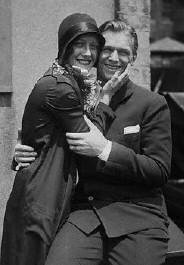 Fairbanks,
Douglas, Jr. (12/9/09 - 5/7/00) Actor;
son of silent star Douglas Fairbanks, Sr., and
Beth Sully; Joan's
first husband (1929 - 1933). The two met after Joan attended a 1927 Los
Angeles performance of the play "Young
Woodley" featuring Doug, then sent him a
note afterwards. Said Joan in CWJC:
Fairbanks,
Douglas, Jr. (12/9/09 - 5/7/00) Actor;
son of silent star Douglas Fairbanks, Sr., and
Beth Sully; Joan's
first husband (1929 - 1933). The two met after Joan attended a 1927 Los
Angeles performance of the play "Young
Woodley" featuring Doug, then sent him a
note afterwards. Said Joan in CWJC:
We were children. (I don't think women should be allowed to marry before they reach 25, men at 30...At that point the mind and lifestyle and sexuality should have developed to a degree that establishes their compatibility...) I think my biggest mistake with Doug was when I tried seriously to become the lady the Fairbanks tribe would have wanted for their prince. I started reading everything in sight, whether I understood it or not, as long as it was classical and recommended by Doug. (If it bored the pants off me I knew I should read it.)...All this could have been good--I certainly learned a lot--but I was so conceited, so self-absorbed, I overlooked one fact: Doug married Joan Crawford, the chorus girl, and maybe that's the woman he really wanted, not the pretender to the throne. I was re-creating the sort of life he'd had with his parents, and he didn't like either one of them very much, so it was the wrong full-circle. I don't know. I never really asked him what went wrong...
...I think I was more sexual than Doug. Besides, we both worked our asses off, and it's a little difficult to work in the proper amount of hanky-panky when you have to get up at four o'clock almost every goddam morning. And on weekends, when we had time, Doug sort of moved with the British colony, and I don't think they ever accepted me and I know damned well they bored me stiff. No, sex wasn't our strong point.
He co-starred with Joan in 1929's Our Modern Maidens. See also the Husbands of Joan entry. And the Dame Edna entry for a 1989 interview with Doug. IMDb info.
Mother's side: Joan's mother was Anna Bell Johnson (1884 - 1958), who was of Irish-Scandinavian descent. Anna Bell's parents were Sylvester Johnson (b. 1859) and Mary Ellen Searles (1863 - 1959). No info on Johnson's parents, but Searles' parents were Joseph Allen Searles (1836 - 1913) and Harriet Rhodes (1838 - 1911). Father's side: Joan's father was Thomas E. LeSueur (1868 - 1938), of French-Canadian descent. No info on Thomas's mother, but his father was Bert LeSueur (b. 1842). Bert's parents were Sarah Phlegar and Martell or Martin LeSueur (1821 - 1904). (Info from www.genealogy.com's Joan listing.)
Addendum, 8/21/05: F. D. Redding writes in to say that the above info on Joan's father's side of the family is incorrect. Here is his version of the patrilineal information, from the RootsWeb.com site:
Father's side: Joan's father was Thomas E. LeSueur (1868 - 1938), of French Huguenot descent. [Redding notes that this branch of the family emigrated from London in the early 1700s, settling in Manakin Town, Virginia, where they lived for several generations.] Thomas's parents were James Howell LeSueur (b. 1842 in Virginia) and Permelia D. "Amelia" James (b. 1845 in Tennessee). James LeSueur was the son of Samuel Wesley LeSueur and Mary Ann Jane LeSueur, who were first cousins as their fathers were brothers. Amelia was the daughter of John J. James and Rhoda Ball. (Info. from RootsWeb WorldConnect's Joan listing: RootsWeb's WorldConnect Project: Le Sueur.)
For information on Joan's stepfather Henry Cassin's family tree, see the Cassin entry.
Pictured is the maternal
side of the family, before Joan's birth (courtesy of US): Top row: unknown,
Joan's father Thomas LeSueur, Joan's aunt Betty Johnson. Bottom row: Joan's uncle (name
unknown), her mother Anna Bell (holding Joan's brother Hal), her grandmother
Mary Ellen Johnson (holding Joan's sister Daisy), her grandfather Sylvester
Johnson. (NOTE: In POJ, Joan says the
girl on her grandmother's lap is her aunt Betty and does not name the older
girl standing behind her. Joan occasionally got a few facts wrong in POJ, so
for now I'm leaving the US description of the picture.)
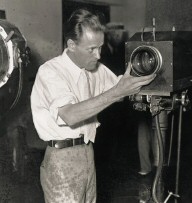 Farnsworth,
Philo T. (8/19/1906 - 3/11/1971). US inventor and television
pioneer.
Farnsworth,
Philo T. (8/19/1906 - 3/11/1971). US inventor and television
pioneer.
From Wikipedia: ...Many inventors had built electromechanical television systems before Farnsworth's seminal contribution, but Farnsworth designed and built the world's first working all-electronic television system, employing electronic scanning in both the pickup and display devices. He first demonstrated his system to the press on September 3, 1928, and to the public at the Franklin Institute in Philadelphia on August 25, 1934.
His August 1934 demonstration included a televised picture of Joan Crawford as it appeared on the cathode tube in the receiving room at the Franklin Institute.
This site's TV page for the projected 1934 image of Joan
Fatal Confinement (aka Della). Joan's 1964 TV pilot "Della" for the proposed NBC series Royal Bay was later released theatrically under the name Della. In 1988, it was released on VHS as Fatal Confinement. See this site's TV: 1960s page for more info on the original Della.
Fay, Frank. Silent-screen star who owned the property across the street from Joan's Brentwood home on North Bristol Avenue. Fay was once married to Barbara Stanwyck; after a marriage-ending violent fight with Fay, Stanwyck sought refuge with Joan. On Sundays Fay would often allow his estate to be used for Catholic fundraisers, which angered Joan because of the people and cars blocking the street. (MD)
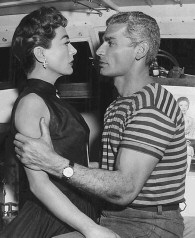 Female
on the Beach. Universal-International, 1955. Directed by Joseph Pevney,
97 minutes. Joan stars in her first film for Universal as "Lynn Markham," a rich widow with a beach-house
who's suspicious of the attractive beach-bum (Jeff Chandler) hanging around. Joan
had specifically requested Chandler for her leading man. Says
Joan in CWJC:
Female
on the Beach. Universal-International, 1955. Directed by Joseph Pevney,
97 minutes. Joan stars in her first film for Universal as "Lynn Markham," a rich widow with a beach-house
who's suspicious of the attractive beach-bum (Jeff Chandler) hanging around. Joan
had specifically requested Chandler for her leading man. Says
Joan in CWJC:
They couldn't title it Female on the Beach today, could they? Women's Lib would have a fit. (Actually, to them I should be some sort of heroine; I brought more men to their knees, or actually ruined them, than any other actress in Hollywood history. They should order their membership to see old Joan Crawford movies; if anyone could handle those mean male bastards, Joan could.)
Seriously, it wasn't a bad picture. I thought Jeff Chandler was excellent, a very bright and handsome actor, and I suppose the only thing wrong with it was the thing that hurts so many melodramas, a lack of credibility. The writers aren't too careful about the plot, they're more concerned with building up certain scenes, and the directors go along with that. Consequently, to use another critical phrase, the parts are better than the whole.
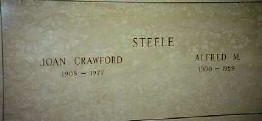 Ferncliff
Cemetery and Mausoleum. Where Joan's ashes are interred, alongside those
of
husband Al Steele. Ferncliff is located in Hartsdale, Westchester County, New
York. Exact location of Joan's remains: Main Mausoleum, Unit 8, Alcove E, Crypt
42.
Ferncliff
Cemetery and Mausoleum. Where Joan's ashes are interred, alongside those
of
husband Al Steele. Ferncliff is located in Hartsdale, Westchester County, New
York. Exact location of Joan's remains: Main Mausoleum, Unit 8, Alcove E, Crypt
42.
Click here to see shots of Ferncliff that I took in March '06. Official website.
 Feud.
8-part anthology TV series created by Ryan Murphy (Glee,
American Horror Story) that debuted on the U.S. TV network
FX on March 5, 2017. Starring Jessica Lange as Joan Crawford and
Susan Sarandon as Bette Davis during the making of the 1962 film
What
Ever Happened to Baby Jane?. (Click on photo to see over a dozen promo photos from the show.)
Feud.
8-part anthology TV series created by Ryan Murphy (Glee,
American Horror Story) that debuted on the U.S. TV network
FX on March 5, 2017. Starring Jessica Lange as Joan Crawford and
Susan Sarandon as Bette Davis during the making of the 1962 film
What
Ever Happened to Baby Jane?. (Click on photo to see over a dozen promo photos from the show.)
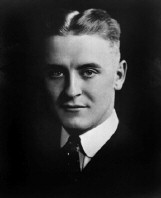 Fitzgerald, F.
Scott. (9/24/1896 - 12/21/1940) At the height of the Jazz Age, Fitzgerald wrote of Joan: "[She]
is doubtless the
best example of the flapper, the girl you see in smart night clubs, gowned to
the apex of sophistication, toying iced glasses with a remote, faintly bitter
expression, dancing deliciously, laughing a great deal, with
wide, hurt eyes. Young things with a talent for living."
Fitzgerald, F.
Scott. (9/24/1896 - 12/21/1940) At the height of the Jazz Age, Fitzgerald wrote of Joan: "[She]
is doubtless the
best example of the flapper, the girl you see in smart night clubs, gowned to
the apex of sophistication, toying iced glasses with a remote, faintly bitter
expression, dancing deliciously, laughing a great deal, with
wide, hurt eyes. Young things with a talent for living."
Fitzgerald made a foray to Hollywood himself in 1931, where he was subsequently fired as writer for the film Red Headed Woman. In 1938 he tried writing for films again, in a 6-month stint for MGM, and this time had a hit--and his only film credit-- with Three Comrades, featuring Margaret Sullavan (co-starring that year with Joan in the less successful The Shining Hour) and Joan-husband Franchot Tone. Hearing the pre-release buzz on Comrades, Joan asked producer Hunt Stromberg to have Fitzgerald write something for her. The resulting project was Infidelity. (JCB)
According to an April '04 New York Times article, the film was initially conceived as a vehicle for Joan, Gable, Gary Cooper, and Tone. (At one point Fitzgerald suggested that it star Myrna Loy, Gable, Robert Taylor, and Tone.) During the project, Fitzgerald wrote to a friend:
...Writing for [Joan] is difficult. She can't change her emotions in the middle of a scene without going through a sort of Jekyll and Hyde contortion of the face, so that when one wants to indicate that she is going from joy to sorrow, one must cut away and then cut back. Also, you can never give her such a stage direction as 'telling a lie,' because if you did, she would practically give a representation of Benedict Arnold selling West Point to the British....
He also made of point of studying Crawford films before he began, and took notes during a screening of Chained:
Why do her lips have to be glistening wet?... Don't like her smiling to herself--or such hammy gestures that most actresses get away with....Cynical accepting smile has gotten a little tired....She cannot fake her bluff, or pretend to.... Her smile brighter in outdoor situation than in drawing rooms...Outdoor girl better....Hearty laughter rather good....A sad smile not bad, but the serious expression best....Absolutely necessary that she feel her lines. Must be serious from first. So much better when she is serious. Must have direct, consuming purpose in mind at all points of the story--never anything vague or blurred. Must be driven.
Fitzgerald labored on the film for months, but the adultery theme brought heat from the Hays Office; eventually Joan turned down the script and the project died. (JCB) (Fitzgerald also later worked on the script for The Women, which, like Red Headed Woman, ended up being finished by Anita Loos. While in Hollywood, he also worked on his last--unfinished--novel, The Last Tycoon, based roughly on the life of Irving Thalberg.)
Said Joan in CWJC: "Scott was one hell of a writer, but he was also a lush, and Metro was sort of killing him by ignoring his scripts. When I told him ["write good"] I also told him to write it as he saw it, not to take too much advice before he started." In her 1973 Town Hall interview, Joan said: "I only remember him coming to my house in California with Helen Hayes and Charlie MacArthur, and all he did was stand in my kitchen near where the liquor was and get very drunk."
Note re the "write good" quote above: In CWJC, interviewer Roy Newquist specifically asks "You are reputed to have told F. Scott Fitzgerald...to 'write good.'" Other sources, however, such as Matthew J. Bruccoli's Some Sort of Epic Grandeur Fitzgerald bio and Fitz girlfriend Sheilah Graham's autobiography, have Joan saying "write hard."
Wikipedia page. Fitzgerald papers at Princeton.
Flagg, James Montgomery. See this site's Flagg art page for more info. See also this photo of Flagg with Joan and portrait circa 1936.
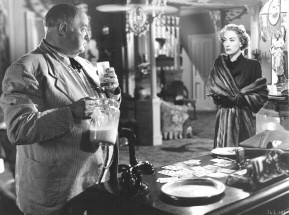 Flamingo
Road. Warner Brothers, 1949. Directed by Michael Curtiz, 96 minutes. Joan
stars as carny-gal "Lane Bellamy," who hooks up with the local sheriff
(Zachary Scott) and incurs the wrath of town bigwig Titus Semple (Sydney Greenstreet).
Flamingo
Road. Warner Brothers, 1949. Directed by Michael Curtiz, 96 minutes. Joan
stars as carny-gal "Lane Bellamy," who hooks up with the local sheriff
(Zachary Scott) and incurs the wrath of town bigwig Titus Semple (Sydney Greenstreet).
Says Joan in CWJC: Another boner. The script missed, Curtiz missed, I missed. It just didn't jell, that's all, and it's another time when my judgment screwed up completely, because while we were shooting it I thought it would be good. I often wonder if that wasn't one of the films I made that was destroyed by bad editing.
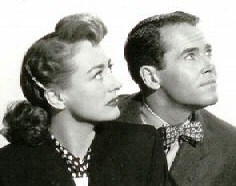 Fonda,
Henry. (5/16/05 - 8/12/82) This
Nebraska-born film legend made his acting debut at the Omaha Community
Playhouse and subsequently appeared in plays in Cape Cod and on
Broadway from 1926 to 1934 before making his film debut in 1935's
"The Farmer Takes a Wife." He would go on to receive two
Oscar nominations for "Grapes of Wrath" (1940) and "Twelve
Angry Men" (1958), before winning an Oscar for his penultimate
film "On Golden Pond" (1981).
Fonda,
Henry. (5/16/05 - 8/12/82) This
Nebraska-born film legend made his acting debut at the Omaha Community
Playhouse and subsequently appeared in plays in Cape Cod and on
Broadway from 1926 to 1934 before making his film debut in 1935's
"The Farmer Takes a Wife." He would go on to receive two
Oscar nominations for "Grapes of Wrath" (1940) and "Twelve
Angry Men" (1958), before winning an Oscar for his penultimate
film "On Golden Pond" (1981).
Fonda appeared with Joan in one film, 1947's Daisy Kenyon, in which he played a troubled WWII vet vying with a cad lawyer (Dana Andrews) for commercial artist Daisy's affections.
In an interview with Charles Castle, published in Castle's 1977 book Joan Crawford: The Raging Star, Fonda speaks extensively about the movie and Joan:
I was a contract player, and had to do it. It wasn't bad, so I couldn't fight too much about it. And the audience reacted to it as I expected them to. If they went to see a Joan Crawford movie, that's fine, and there was no reason not to have liked her because she was good. It was just one of fifty or sixty movies I did that were just churned out. It was different, because it was Joan Crawford. Acting with her was such a consummate thing....
With her you never saw the wheels turning. She was very true. She was the part, the character, not an actress merely playing the part. She had charisma or personality. She would be somebody when she walked onto the stage before she even opened her mouth, whether she was known to be Joan Crawford or not. She would be somebody that you would think of and notice....
When I did this one film with her, and I don't want to say it in a put-down way, she was obviously the star, and she had demands. But they were not outrageous demands. She wanted the stage a certain temperature and I didn't object to that. It was colder than most people would have---it was important to her that the stage be cool....
I was told that she always gave her leading men and all the principals on the picture presents on opening day....My present from her was a crystal vase from Denmark. It was a beautiful thing. I wasn't used to being given a present by the leading lady or by anybody else when I started a film, so I was unprepared to give her anything. But I discovered that she chewed double-mint gum, and I bought her a carton-full and gave her that.... [My note: In Shaun Considine's 1989 book Bette and Joan: The Divine Feud, Fonda is quoted from his bio My Life as having received another gift from Joan: a sequined jockstrap---which she subsequently invited him to model. Said Fonda: "I was carrying her up the stairs for a scene we were filming. When she whispered the invitation, I nearly dropped her." No word on whether he accepted.]
I knew Bette [Davis] a long time, and I have worked with her twice or three times, and I was very aware of Bette's mannerisms, but I was never conscious of Joan having any. I found working with Joan very relaxed. Very warm.... Joan was a star in every sense of the word. She didn't remind you of it in any particular way. You just knew it. And you didn't think any less of her for it.
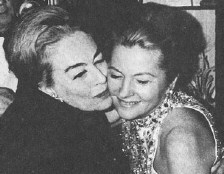 Fontaine,
Joan. (10/22/17 - 12/15/13) This Oscar winner (Hitchcock's
Suspicion, '41) and sister of Olivia de Havilland made her film debut
in Joan's 1935 film No More Ladies and also appeared in 1939's The
Women. From Fontaine's autobiography No Bed of Roses (William Morrow and Co., 1978):
Fontaine,
Joan. (10/22/17 - 12/15/13) This Oscar winner (Hitchcock's
Suspicion, '41) and sister of Olivia de Havilland made her film debut
in Joan's 1935 film No More Ladies and also appeared in 1939's The
Women. From Fontaine's autobiography No Bed of Roses (William Morrow and Co., 1978):
In
the spring on 1939, MGM signed me to play in The Women, Clare Boothe Luce's
succesful stage play, to be directed by George Cukor...
The differences
in the stars made my mind boggle. Miss Shearer, not only because of her beauty
and talent, but also because her husband, Irving Thalberg, was the most important
producer at MGM, had long been the queen of the lot. Hers was a dignified,
delightfully warm demeanor. A maid, dressed in black uniform, with frilly cap
and apron, attended her before each take, handing the star a mirror and powder
puff from a makeup tray. Joan Crawford, on the other hand, had the democratic
touch, knowing every grip and electrician by name...My particular remembrance is
of Joan in a gold lame halter top and slit evening skirt. Joan kept a ball of
yarn tucked in her midfriff as she knitted away between setups.
I had
known Joan Crawford since my small part in No More Ladies...Since Miss Shearer
was the gracious lady of the lot, Miss Crawford decided to be the cultured one.
I often heard Joan's operatic vocalizing emanating from her studio bungalow at
lunch hour. She wore huge horn-rimmed spectacles between takes or in her
sound-stage dressing room, where an immaculately uniformed chauffer, complete to
puttees, placed a portable phonograph each morning. Strains of Manon or Tosca
would seep onto the nearby set during rehearsals, much to the annoyance of our
director.
One afternoon, Russian actor Ivan Lebedeff paid a call on Miss
Crawford and was invited into her stage dressing room. In ten minutes Ivan came
pelting out, white of face. As I happened to be close by and knew him, he rushed
over to me. In shock, he blurted out, 'Poor Joan! She's just told me that after
her tragic life with men, she can no longer find sexual satisfaction unless she
is tied to a bedpost and whipped!' He staggered away, hands against his ashen
face. I could only chuckle. I had read the same chapter in Psychopathia
Sexualis, too! Joan's imagination was on the dramatic side...and she obviously
was an inspired conversationalist.
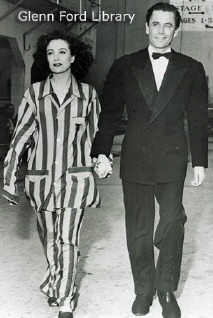 Ford,
Glenn. (5/1/16 - 8/30/06) Ford
made his debut in 20th Century-Fox's 1939 film "Heaven with
a Barbed Wire Fence" and went on to star in such notable films
as 1946's "Gilda," 1953's "The Big Heat," and
1955's "Blackboard Jungle." (Along with 1978's "Superman,"
a film that Joan was reportedly approached about doing just prior
to her death in 1977.) His final appearance was in the 1991
TV movie "Final Verdict."
Ford,
Glenn. (5/1/16 - 8/30/06) Ford
made his debut in 20th Century-Fox's 1939 film "Heaven with
a Barbed Wire Fence" and went on to star in such notable films
as 1946's "Gilda," 1953's "The Big Heat," and
1955's "Blackboard Jungle." (Along with 1978's "Superman,"
a film that Joan was reportedly approached about doing just prior
to her death in 1977.) His final appearance was in the 1991
TV movie "Final Verdict."
He and Joan had a brief fling around 1942. (See the picture to the right, taken in 1942 on the Columbia lot.) From a soon-to-be-released bio (Glenn Ford: A Life in Film):
The Ford-Crawford friendship was indeed a bit more intimate than either star admitted publicly at the time. "Joan and I had a brief affair," Glenn admits today. "It was never serious, but we did enjoy each other's company for a while. One evening up in her bedroom, we had a bottle of champagne, and she said 'You can make love to me if you can get my girdle off.' So I began struggling to remove this stubborn, rubber foundation garment. It was so tight, it took quite a while. She wouldn't move, wouldn't help me at all. Finally, it came off...almost threw me across the room!" The Crawford fling burned out quickly. "She was too powerful for me to be in love with," Glenn says. "She was very much sufficient unto herself."
Joan doesn't mention girdles and Ford in the same breath in her 1962 autobiography "Portrait of Joan," but she does say there: Glenn Ford and I had many mutual interests, paramount among which was the artisan side of our business. We'd run his pictures, we'd run mine, studying production techniques, giving each other constructive criticism. Both of us were a little solitary. Our relationship was in the nature of a good aperitif.
Ford Startime "Talent Scouts." Joan appeared as a scout on this TV show on 2/23/60, "discovering" Collen Dewhurst.
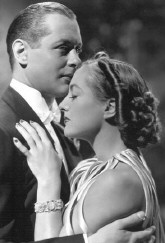 Forsaking
All Others. MGM, 1934. Directed by W.S. Van Dyke, 82 minutes. Joan stars
as "Mary," who's about to marry childhood friend/cad (Robert
Montgomery) but is wooed by her other childhood
friend/nice guy (Clark Gable,
in their 6th film together). Says
Joan in CWJC: Others wasn't a particularly
strong picture, but there was Clark again, plus Bob Montgomery. Forgettable
but pleasant.
Forsaking
All Others. MGM, 1934. Directed by W.S. Van Dyke, 82 minutes. Joan stars
as "Mary," who's about to marry childhood friend/cad (Robert
Montgomery) but is wooed by her other childhood
friend/nice guy (Clark Gable,
in their 6th film together). Says
Joan in CWJC: Others wasn't a particularly
strong picture, but there was Clark again, plus Bob Montgomery. Forgettable
but pleasant.
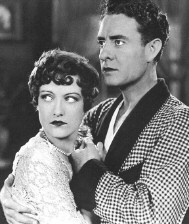 Four
Walls. MGM silent, 1928. Directed by William Nigh,
60 minutes. Joan plays "Frieda," the moll of neighborhood gangsta John
Gilbert, who's sent to prison and subsequently
reforms. Says Joan in CWJC: ...I was back with John Gilbert again, and the chemistry
worked all over again, even stronger.
Four
Walls. MGM silent, 1928. Directed by William Nigh,
60 minutes. Joan plays "Frieda," the moll of neighborhood gangsta John
Gilbert, who's sent to prison and subsequently
reforms. Says Joan in CWJC: ...I was back with John Gilbert again, and the chemistry
worked all over again, even stronger.
In the 1930s, Joan's favorite perfume was Jungle Gardenia by Tuvache (launched in 1933).

From fragrantica.com (click on perfume/cologne name to go to website page for more complete info):
Jungle Gardenia perfume was originally launched in 1933 by the New York-based perfume company Tuvachι. The fragrance was reformulated a few times: in1950 by Jovan and in 1995 by Coty. The fragrance contains notes of greens, bitter orange, clary sage, cyclamen, gardenia, tuberose, heliotrope, tarragona, violet leaf, lily of the valley, jasmine, ylang-ylang, oak moss, benzoin, sandalwood and musk.
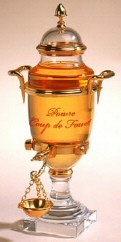
In a March 1963 magazine interview with Paul Denis conducted at NYC's Chauveron, Joan said, "I always use cologne in the morning. Never perfume until lunch or after. I like 4711 cologne. I like real men's cologne scents....I never wear heavy perfume. Now I have on White Ginger from Honolulu [journalist Denis's typed notes from the article re White Ginger: "carries it in small circular gold case, with sponge that's soaked with perfume. rubs sponge along arms, etc."]. My favorite perfume is Poivre by Caron. It's clean, wonderful."
From fragrantica.com:
4711 Original Eau de Cologne by Maurer & Wirtz is a Citrus Aromatic fragrance for women and men. 4711 Original Eau de Cologne was launched in 1792. The nose behind this fragrance is Wilhelm Muelhens. Top notes are orange oil, peach, basil, bergamot and lemon; middle notes are cyclamen, lily, melon, jasmine and bulgarian rose; base notes are patchouli, tahitian vetiver, musk, sandalwood, oakmoss and cedar.
Poivre by Caron. It took rare audacity, this hot spicy pepper top note, backed up by a typically Caron rich floral heart, and woody base notes. As the most powerful scent, pepper appeals to both men and women. Poivre was launched in 1954. The nose behind this fragrance is Michel Morsetti.
On Poivre, from the Yesterday's Perfume blog: Notes: Red and black pepper, clove, carnation, ylang ylang, jasmine, opoponax, cedar, sandalwood, vetiver, oakmoss, musk. A heady mix of florals armed with explosives and spice, Poivre by Caron could easily be a niche scent today. It's hard to imagine the stereotypical 1950s woman warming up to it — until you remember that not everyone in the 50s was Sandra Dee and Doris Day. (Even Sandra Dee and Doris Day probably weren't Sandra Dee and Doris Day!)

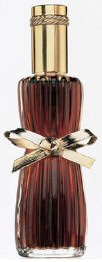
Joan said in her 1971 autobiography My Way of Life that the three scents she "would never want to live without" were Youth Dew by Estee Lauder (launched 1953); Royall Lyme, a man's cologne (1957); and Spanish Geranium by Lanvin (1925).
From fragrantica.com:
Youth-Dew by Estιe Lauder is an Oriental Spicy fragrance for women. Youth-Dew was launched in 1953. The nose behind this fragrance is Josephine Catapano. Top notes are aldehydes, orange, spices, peach, bergamot, narcissus and lavender; middle notes are cinnamon, cassia, orchid, jasmine, cloves, ylang-ylang, rose, lily-of-the-valley and spicy notes; base notes are tolu balsam, peru balsam, amber, patchouli, musk, vanilla, oakmoss, vetiver and incense. [See also a February 10, 1973, letter from Joan to a fan in which she says, "Yes, I do love Estee Lauder's Youth Dew fragrance in her perfume, cologne, bath oil and soap."]
Royall Lyme. Derived from an authentic island formula favored by colonial Victorian gentlemen. This delightfully crisp all-day refresher combines the oils of the plumpest West Indian Royall limes with 77 rare essential oils to produce a zestfully unobtrusive yet undeniably lime scent. A timeless, cooling essential for after shower or shave
From cleopatrasboudoir.com:
Spanish
Geranium:
Gιranium D'Espagne by Lanvin: launched in 1925, created by Madame Marie
Zede, and later may have been tweaked by Andre Fraysse. WWII halted
production of the perfume but by 1950 it was re-introduced and renamed
Spanish Geranium in 1951 for the US market. A fresh, spicy floral perfume with dominant
geranium and rose notes.
- Top notes: aldehydes, geranium, lemon, bergamot
- Middle notes: palmarosa, carnation, rose geranium, pepper
- Base notes: tonka, oakmoss, ambergris, patchouli, benzoin, civet, sandalwood
It starts out very crisp with the green, herbal,
spiced, pungency of a fresh geranium blossom, mixed with sun-drenched
creamy rose geraniums and vibrant lemons or bergamot too, then it
mellows out to a beautiful oakmoss , palmarosa, patchouli and amber
blend with hints of sweet benzoin, sandalwood and civet. After an hour, I
can still detect the lemon and fresh geranium notes. The perfume is
very heady, and definitely a wonderfully made true to life geranium
perfume.
The perfume is almost masculine in its composition and reminds me a
little of Early American Old Spice, because of the geranium notes.
Plus
a Spanish
Geranium review
from a reader of AustralianPerfumeJunkies.com.


 Frank,
Robert. Photographer and filmmaker. As a photographer, he's
perhaps best known for his 1958 book The Americans, which
consists of shots taken during a 2-year road trip across the country.
According to his Wikipedia
entry, he took over 28,000 photos on this expedition, with only
83 finally appearing in the book, one of which was this one featuring
Joan; shot in Detroit, 1956. (Click on photo to see large version.)
This photo also appeared on the inside cover of the Rolling
Stones' 1972 album "Exile on Main Street."
Frank,
Robert. Photographer and filmmaker. As a photographer, he's
perhaps best known for his 1958 book The Americans, which
consists of shots taken during a 2-year road trip across the country.
According to his Wikipedia
entry, he took over 28,000 photos on this expedition, with only
83 finally appearing in the book, one of which was this one featuring
Joan; shot in Detroit, 1956. (Click on photo to see large version.)
This photo also appeared on the inside cover of the Rolling
Stones' 1972 album "Exile on Main Street."
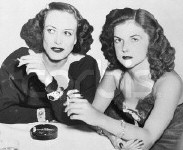 Frazier,
Brenda. This ultimately troubled New York society girl made her debut in 1938
and was promptly
embraced by the Hollywood community, including Joan.
Frazier,
Brenda. This ultimately troubled New York society girl made her debut in 1938
and was promptly
embraced by the Hollywood community, including Joan.
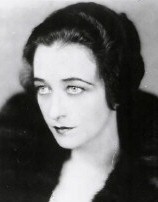 Frederick,
Pauline. (8/12/1883 - 9/19/1938) Frederick began her career as a chorus
girl, soon graduating to lead roles in Broadway musical comedies, then dramas.
She signed with Adolph Zukor's Famous Players Company in 1914 and debuted on
film a year later at the ripe old age of 32. Usually cast as variations
of a "woman of the world" in many uneven films, her most
famous role was probably 1920's Madame X. She appeared in 67
films and continued acting on the stage before her death from asthma in 1938.
Frederick,
Pauline. (8/12/1883 - 9/19/1938) Frederick began her career as a chorus
girl, soon graduating to lead roles in Broadway musical comedies, then dramas.
She signed with Adolph Zukor's Famous Players Company in 1914 and debuted on
film a year later at the ripe old age of 32. Usually cast as variations
of a "woman of the world" in many uneven films, her most
famous role was probably 1920's Madame X. She appeared in 67
films and continued acting on the stage before her death from asthma in 1938.
Frederick co-starred with Joan in one film, 1931's This Modern Age, playing Joan's mother in a role originally intended for Marjorie Rambeau. (Trivia: Frederick and Rambeau had something else in common: Both were briefly married to the drug/booze-addled writer/actor Willard Mack; Rambeau from 1913 - 1917, Frederick from 1917 - 1919.)
Said Joan in POJ:
Acting with Pauline Frederick was a stirring experience for me. The celebrated actress I'd met backstage with Paul Bern when I was a novice in Hollywood, the first legitimate theater I'd ever seen--now we were working together every day and I had the opportunity of knowing her, savoring her quality. Her voice had the tone and range of a rare instrument, but that was just one adjunct of her charm, as were her physical beauty and dramatic ability. At the core of the woman was an exquisite maturity. She had utilized her intelligence, expanded it, she was living proof of what a woman and an actress could become. Imagine my reaction when she told everyone, "If they'll give this child a chance she'll do big things. Joan is an actress."
Excellent fan site. IMDb page. Internet Broadway Database.
 Freeman,
Dore (Isadore). (? - 11/15/1988)
Freeman,
Dore (Isadore). (? - 11/15/1988)
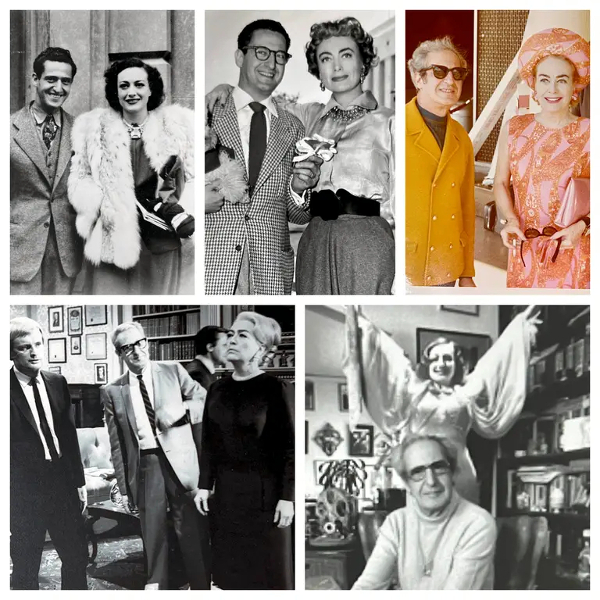
Longtime Joan friend and publicist and, later, collector of Joan memorabilia. Freeman was a young Western Union messenger in the early 1930s when Joan arrived at Grand Central Station and was besieged by aggressive reporters demanding to know when she'd be marrying then-beau Franchot Tone. Freeman yelled out, "Tell them 'Time will tell!'" Joan told reporters just that, and later delivered a watch to Freeman with the inscription, "Time will tell. Love, Joan Crawford."
Joan later helped Freeman get a job as an MGM publicist and maintained a personal and professional relationship with him until her death in 1977. (See the Letters section of this website for over 50 letters between the two from 1940 to 1976.)
Los Angeles Times Freeman obituary (November 20, 1988):
Dore Freeman, who accumulated what is believed to be the greatest collection of memorabilia of any single film star--20,000 still photos of Joan Crawford, 3,000 personal snapshots, remnants of her wardrobe and even her Social Security card--died Tuesday of the complications of a stroke.
The veteran Metro Goldwyn Mayer publicist and photographer was 76 and was at work as a consultant for the Turner Entertainment Co., which purchased the MGM film library.
Freeman's fascination with Crawford began when he was a Western Union messenger and, along with hundreds of newsmen and fans, was meeting her train at Grand Central Station.
It was the 1930s and she was at the height of her career. Privately she was divorcing Douglas Fairbanks Jr. and was in the process of marrying Franchot Tone, who was secreted in her private rail car.
"Tell them, 'Time will tell,' Joan," he yelled.
She repeated the advice to the crowd, and a few days later one of Freeman's counterparts visited him bearing a gold watch. Inside it said: "Time will tell. Love, Joan Crawford."
Thus began a relationship that did not end until Crawford's death in 1977.
She helped him get a job at the MGM publicity department, where he worked under every studio head from Louis B. Mayer to Alan Ladd Jr. At his retirement in the early '80s, he was head of the publicity still department at the studio.
But his primary preoccupation remained with Crawford. His home became a repository for mannequins, portraits and the dozens of gifts she had sent him.
Freeman, a bachelor, lived alone with two schnauzers named for Crawford's adopted children, Christopher and Christina.
 Frost,
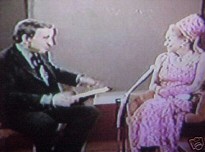
David. According to the IMDb, Joan appeared on Frost's interview program on 1/16/70,
4/21/70, and 10/7/71. See the '70s
TV page for more info and photos.
Frost,
David. According to the IMDb, Joan appeared on Frost's interview program on 1/16/70,
4/21/70, and 10/7/71. See the '70s
TV page for more info and photos.